Women, Peace and Security at 25: A Czech Perspective
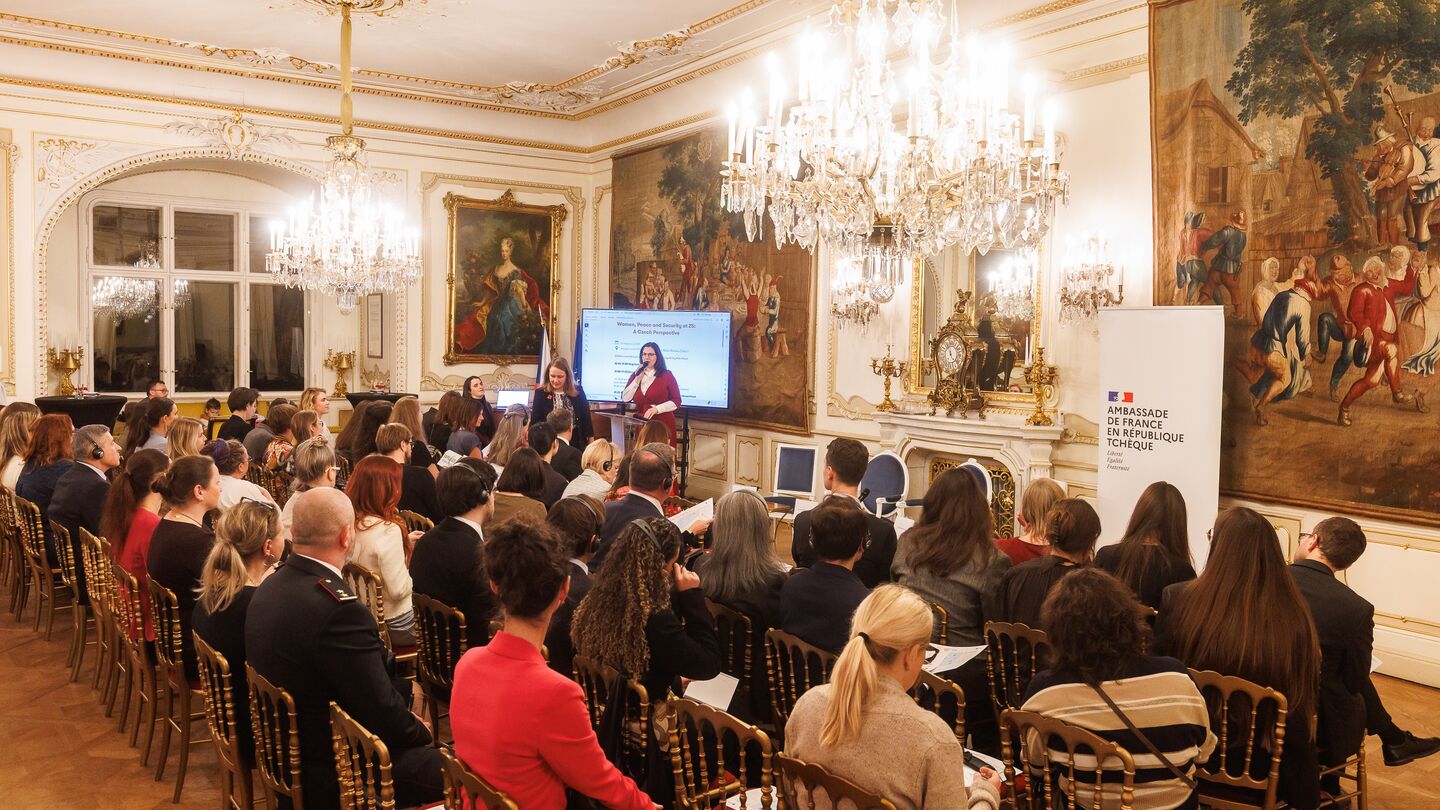
The Institute of International Relations co-organised the ceremonial evening Women, Peace and Security at 25: A Czech Perspective, held on 11 November 2025 at the Embassy of France in Prague, Palais Buquoy. The event took place under the auspices of the President of the Czech Republic and marked the 25th anniversary of UN Security Council Resolution 1325, as well as the adoption of the third Czech National Action Plan for 2026–2030.
The evening opened with remarks by the French Ambassador, H.E. Stéphane Crouzat, who highlighted France’s long-standing commitment to advancing the Women, Peace and Security agenda. He was followed by the Government Commissioner for Human Rights, Klára Šimáčková Laurenčíková, who stressed that today’s security challenges cannot be addressed without recognising women as active contributors, not merely as victims. A special message from the President of the Czech Republic, Petr Pavel, was then read out, underlining the significance of Resolution 1325 for both the Czech and international contexts.
The main part of the programme consisted of two panel discussions. The first, focused on the domestic implications of the WPS agenda, was chaired by our researcher Míla O’Sullivan and featured Eva Valentová from the Association for Integration and Migration, Radan Šafařík from the Office of the Government of the Czech Republic, and Lenka Vochocová from the Faculty of Social Sciences at Charles University. The discussion explored the implementation of the agenda in the Czech Republic – from its historical development and institutional support to funding, women’s participation in security structures, and examples of good practice within civil society and academia.
The second panel was moderated by our researcher Ondřej Horký-Hlucháň, who was joined by H.E. Emily McLaughlin, Ambassador of Canada, Martin Pizinger from the Ministry of Foreign Affairs of the Czech Republic, and Ludmila Kucer from CARE. Together, they examined how different countries – including Canada, France and Ukraine – incorporate gender perspectives into their security policies. The panellists shared insights into applying WPS principles in foreign missions, humanitarian responses and development cooperation.
Throughout the evening, the WPS agenda was presented not only as a matter of gender equality but as an essential component of democratic governance and effective security policy.
On behalf of the Institute of International Relations, we extend our thanks to all partners involved in preparing the programme. The collective energy and strong participation demonstrated how prominently the Women, Peace and Security agenda resonates within the Czech context. You can explore the atmosphere of the evening in the photo gallery attached.