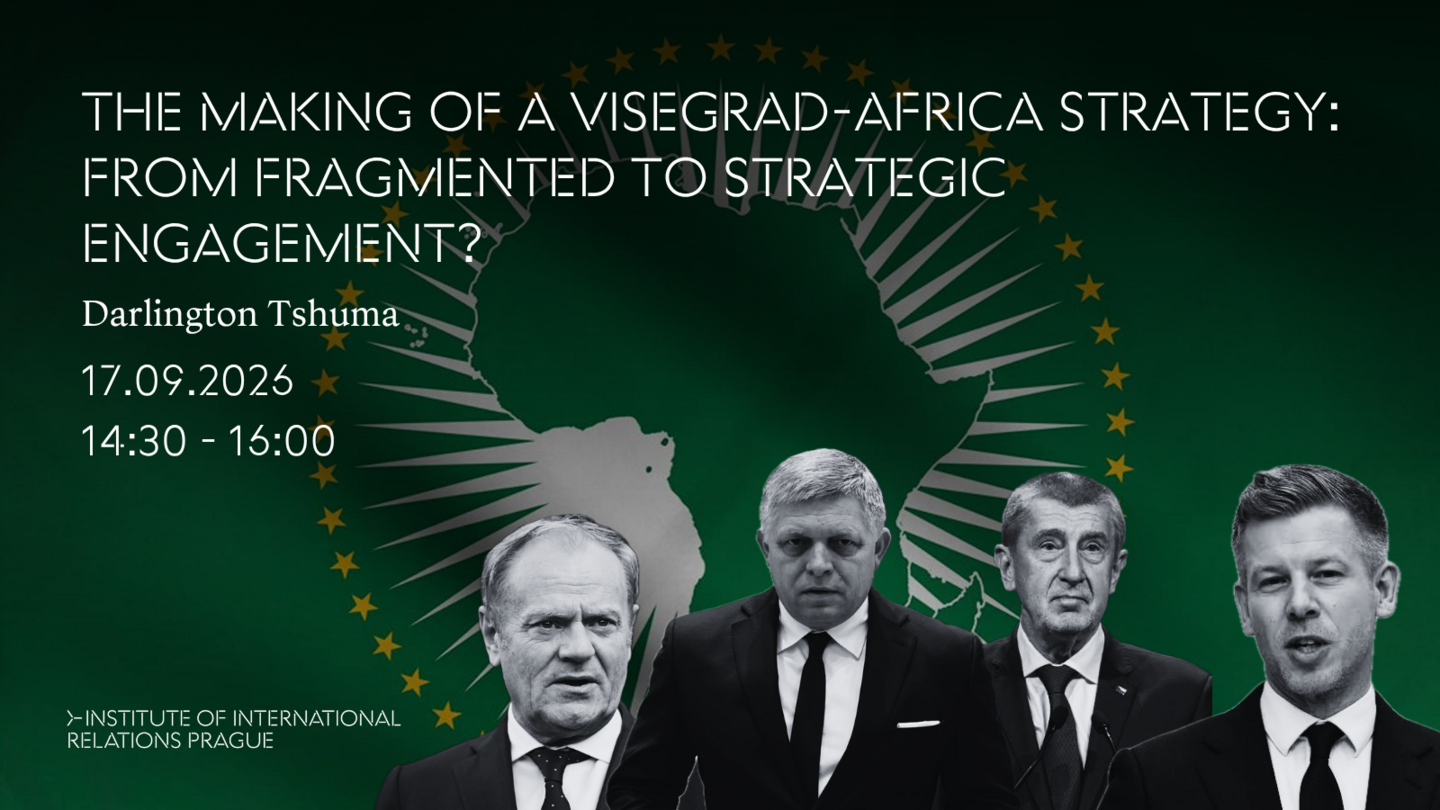
The making of a Visegrad-Africa strategy: from fragmented to strategic engagement?
It is our pleasure to invite you to the presentation of the policy paper “The Making of a Visegrad–Africa Strategy: From Fragmented to Strategic Engagement?” by our Think Visegrad Visiting Fellow, Darlington Tshuma, examining how current political and global shifts could create new momentum for a more coherent and strategic V4–Africa partnership.
17. 9. 2026 (14:30)
Language: English Institute of International Relations Prague (Nerudova 257/3, Prague 1)
Developments within the Visegrad Group (V4) and in the wider international environment create a strategic opening to rethink the foundations of a V4-Africa engagement and develop a more coherent, ambitious and mutually beneficial partnership. On one hand, Europe’s renewed interest in deepening relations with African countries and on the other, political dynamics within V4, specifically Viktor Orban’s departure in Hungary could create greater space for intra-group convergence and for V4 to “re-emerge” as a cohesive and strategic bloc.
For African countries, significant cuts in aid by traditional western donors is prompting many countries to look in-ward while simultaneously recalibrating partnerships with external actors; including European countries, the United States, China, Russia, Gulf countries and others. This diversification of partnerships and a pivot towards trade, investment, technology and skills transfer and strategic security partnerships reflect structural shifts in how Africa engages the world. V4 countries are particularly well positioned to contribute to this transition. Drawing on their “transition experience” of mobilising private and public resources and FDI, they possess valuable experiences for African countries seeking to reduce reliance on aid, strengthen productive capacities and mobilise domestic resources to advance economic sovereignty.
For V4 businesses and economic actors, Africa’s demographic expansion, growing consumer markets and abundant resource endowments and reserves of critical minerals offer huge potential. There is also considerable scope for V4-Africa countries to develop a shared agenda on global governance, including strengthening international law and the future of multilateralism.
However, realising this potential will require African countries actively developing strategic engagements with the bloc and addressing contentious issues that underlie Europe-Africa relations, from migration, peace and security to asymmetrical power relations. Public diplomacy, cultural exchanges, academic partnerships and collaboration across think tanks and research institutions can provide important platforms for trust building and mutual learning.
Speaker:
Darlington Tshuma is a researcher, development practitioner and policy strategist. His work spans various aspects of governance in Africa including colonial encounters, human rights, democracy, gender, human security, African development, African nationalism, leadership, and contemporary African politics. He is a Research Fellow - Africa Programme at the International Affairs Institute in Rome, Italy and a Think Visegrad Visiting Research Fellow at the Institute for International Relations, Prague.
Speakers

Registration
Topics and regions


Related articles