Three Scenarios for Syria’s Future: IIR Study Presented at the European Parliament

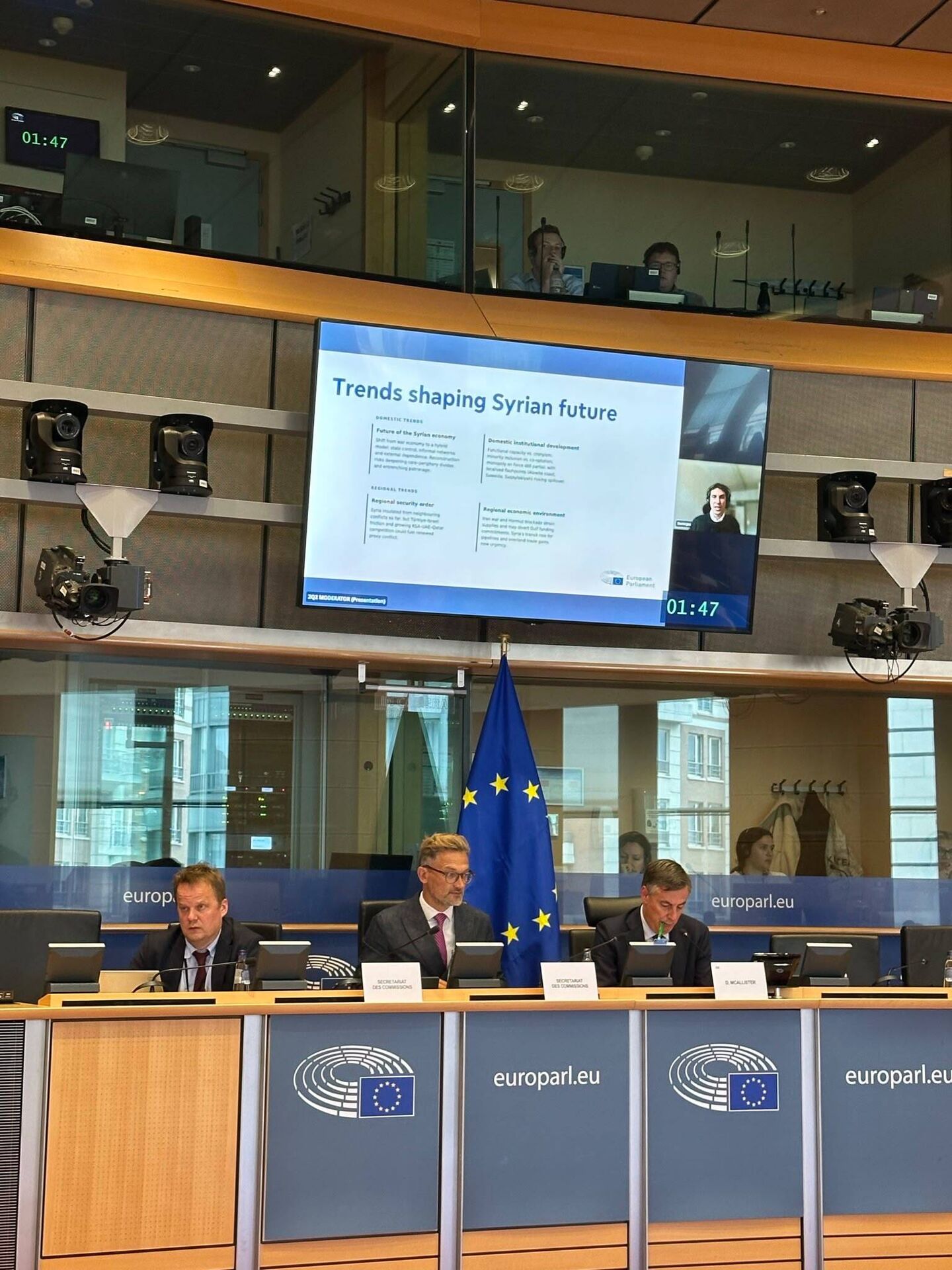
On 3 June 2026, our researcher Jan Daniel presented a study on Syria before the European Parliament’s Committee on Foreign Affairs (AFET). The study, commissioned by the European Parliament, examines the emerging political order in Syria, its possible future trajectories, and the implications for the European Union.
The study was prepared within the framework of a project coordinated by TEPSA (the Trans European Policy Studies Association), led by Jan Daniel and co-authored by Anna Filippi and Clément Steuer, assesses the current shape of Syria’s emerging political order and explores how future political, economic and regional developments may affect the country’s stability.
As Jan Daniel explained during the presentation, “the trajectory of Syria's post-conflict development will be shaped less by formal political arrangements and much more by the internal dynamics through which actual authority is translated into inclusive reconstruction and governance or lack thereof.”
The study identifies several key trends that are likely to shape Syria’s future, including economic transformation, institutional development, regional security dynamics and the influence of external actors. Based on these factors, the authors outline three possible pathways for Syria’s development: state consolidation, authoritarian stabilisation and renewed territorial fragmentation. The research also examines the role that the European Union can play in supporting a stable and inclusive political order. “We assess that the European Union actually retains significant leverage to shape these three pathways and maybe even to help shift the tracks between them,” Daniel noted before members of the committee.
According to the study, long-term stability will depend not only on reconstruction efforts but also on whether political and economic arrangements are able to address the needs of different communities across the country.
You can watch the full presentation and the subsequent discussion on the European Parliament's website here.

Related articles



paper


paper