Serbia’s return to political normality
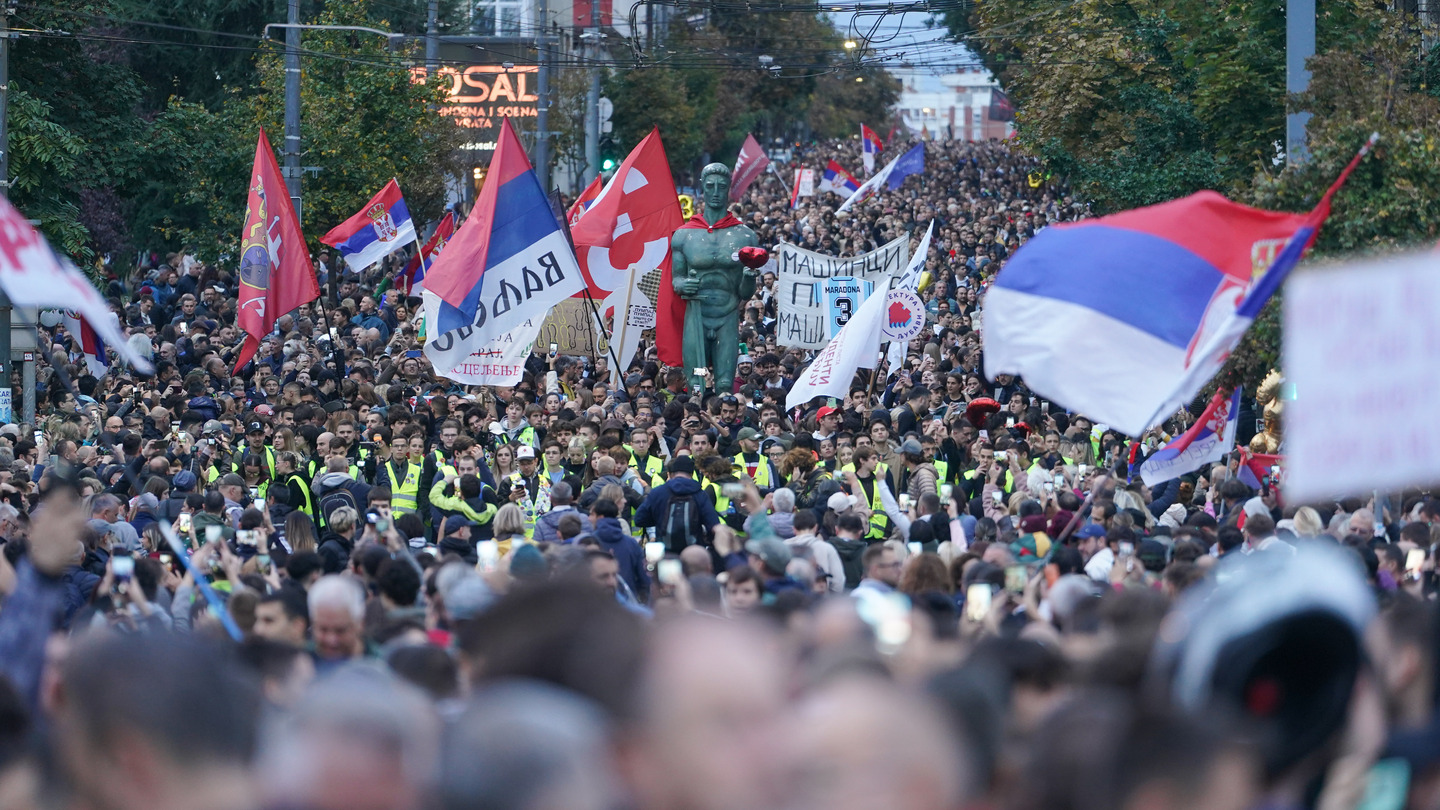
Vučić promises to be back. Serbia’s new majority has 90 days to form a government and make that impossible.
A few days after the election, Aleksandar Vučić posted a video, in which he appeared with his friend Viktor Orbán, who lost power in Hungary earlier this year. At the end, the two promised to be back, echoing the Terminator from 1984. The October election results show that voters moved on and do not want to watch old movies. The Student List won 52.7% of the vote and 140 of 250 seats, while Vučić’s Serbian Progressive Party (SNS) took 39.2% and 104 seats.
Now the new parliament has to form a government and do what many hope for – turn the electoral mandate into a lasting renewal of the existing institutions. In his inaugural address, Aleksandar Čupić, the newly elected Speaker of the National Assembly of Serbia, pledged to restore the dignity of the legislative body.
But the machinery Vučić built over 14 years is still in place, including loyalists who have money, wield influence in the security services, and control nearly all of Serbia’s local governments, alone or in a coalition.
The task ahead of the Student List is not an easy one – to dismantle and liberate that captured state.
A movement nobody owns
The Student List’s greatest achievement is the bottom-up mass mobilisation, relatively unusual in contemporary politics. Another unique feature of the movement is its average academic qualification. By the movement's own account, 160 of the 250 names on its electoral list hold PhDs, which led some analysts to suggest that the new assembly is the most highly educated parliament in the world.
The popularity of the home-grown political movement was largely the product of discipline and persistence. Now the carriers of political change have to deliver. Vučić’s people spent two years insisting that the protests were foreign made, but they simply were not. Russia’s Foreign Intelligence Service, which warned in September 2025 of a “Serbian Maidan” prepared in Brussels, treated the movement as an enemy, not a client. In a statement, Russia accuses EU of orchestrating regime change in Serbia. Not receiving an endorsement from Russia, means that Moscow had no power over the movement and people with pro-Russian attitudes did not have a significant presence, if at all, among the movement members.
Going ahead, three levels of attitudes will matter to decisions made in this transitional period. The sentiments of the electorate show that the majority of Student List voters hold pro-European views. A June 2026 survey found that 75% of Student List supporters want closer ties with the EU, and only 10% want closer ties with Russia. Regarding the movement structure, the Student List mobilized voters with different views – including pro-European, far-left environmentalists, as well as people with conservative and nationalist stances on Kosovo.
While the members of the movement is ideologically diverse, and they all unite around the need for rule-of-law reforms. Ideological differences are unlikely to affect the formation of the new government, yet their existence may become more prominent in the future. Thus, keeping foreign policy out of the early debate may be the most effective way to hold this ‘coalition’ together, while internal reforms are at stake.
Finally, the attitudes of the 140 MPs of Student List who are now formally empowered by the parliament will have the most weight in decision-making and the MPs will be responsible for delivering reforms in line with the students’ demands, a process in which the bottom-up nature of the movement will have to prove its durability.
The captured state starts to crack
The victory of the Student List itself was sufficient to start making the system crumble. Once the pressure from the top disappeared, institutions were quick to turn their backs to Vučić, which shows how fragile the structure of the captured state is. Over 70 arrests followed the election results.
Within days, detentions included the chief of criminal police and the owner of a bank, and prosecutors began investigating election abuse. Milan Radoičić has apparently fled Serbia since the 25 October election, and a Belgrade court has now ordered his detention. Radoičić was vice-president of Srpska Lista (Serb List), the largest Kosovo Serb party, which Belgrade under Vučić backed. Radoičić, seen as a ‘kingpin’ operator among Serbs in northern Kosovo is currently investigated over the 2023 armed attack on the village of Banjska (Banjske) in Kosovo. Another key figure, Dragan Vučićević, the owner of the Informer television, was detained on suspicion of "spreading panic" and "obstruction of justice".
Prosecutors in Serbia are now showing an institutional autonomy that they either could not or would not exercise previously. Once the political pressure was lifted, parts of the prosecution began to perform their functions more independently. Prosecutors dealing with organized crime, for instance, have opened proceedings to establish whether some of them had been subjected to unlawful surveillance under the previous government. Some officials are clearly repositioning themselves in anticipation of a new political patron, while others seem genuinely committed to restoring the integrity of the system. This is already the first lesson to keep in mind: a captured state falls quickly, but it can also be captured again.
Key tasks ahead of the new government
Task 1: Elections
The Student List needs a president who is an ally. The presidential election will take place on December 27th, 2026, following an announcement by Aleksandar Čupić, the newly elected President of the Sebian Assembly. Vučić stepped down as president in September 2026 to run for prime minister. Having served two consecutive terms, he is constitutionally barred from seeking the presidency again. SNS had not, as of early November, confirmed a presidential candidate and was reportedly inclined to abstain. But this decision is yet to be confirmed.
The new government will have to clean the voting register of fake passports and “dead souls”, and other phenomena of Balkan electoral politics. Currently, there is an ongoing audit in line with the European Commission’s recommendations for an electoral reform.
The third important step is to call snap local elections – the sooner, the better. Vučić’s SNS party holds most power at the local level, and controls local governments and mayors through formal and informal means. The new government wants to introduce a new framework for municipal elections including stronger majoritarian elements. According to the current rules, the next local vote will be held in the second part of 2027 and the spring of 2028.
Since this is a long period, the hope is that snap elections will be called earlier. Municipal officials tied to SNS and Vučić have lost legitimacy, and it is likely that some resign much earlier if they feel threatened by the restoration of the rule of law. Throughout Serbia, employees in theaters, museums, culture associations, schools and hospitals are demanding that SNS-appointed managers immediately step down.
Ideally, the snap elections would repeat the results of the Student List from the parliamentary vote in October 2025. Without the Student List having its own mayors and power over municipalities, the reforms promised by the Student List will be a challenge.
Without these initial steps, reform efforts risk failure
Task 2: Security and Rule of Law
The next big step for a new government is to cut the vicious circle of organized crime, and misuse of intelligence tied to the criminal world. The new government has the uneasy task to clear the public administration from Vučić’s loyalists through lustration. The trap is revanchism, especially if methods of the old regime are used. One important measure that the Student List prioritizes in its program is to establish an independent Special Prosecutor’s Police to investigate corruption and cut political pressure on courts and prosecutors.
Rule-of-law actions will likely discourage companies close to the previous regime or limit their participation in the economy, including foreign ones. Now the Student List promises that every contract signed by the state will be public. Many deals under Vučić came from corruption schemes, and stricter rule of law may push firms using dirty money to withdraw, especially in the construction sector. The question is how to preserve economic growth while fighting corruption. If growth slows and disillusion spreads, SNS can recover, using nationalism to accuse the government of treason.
Task 3: Media
The Student List believes that ‘No single center of power, be it government, media owner, or distributor, should be allowed to control public information. Yet, reforming the media sector will not happen overnight. “Yesterday, I received a call from the national television for the first time in ten years”, says an academic close to the Student List who shared insights for this publication. – “They never called me before to comment on anything, now they are obviously looking for the new master.”
Five television channels in Serbia are seen as loyal to the old regime. In addition to the public RTS, Serbia’s media regulator (REM) awarded four national TV frequencies in 2022 to Happy, Pink, B92, and Prva widely seen as government-friendly. The expectation is that tabloids and disinformation multipliers sponsored by the previous regime will naturally vanish or at least diminish their power. However, reforming state media may take some time.
Some of Vučić 's key mouthpieces, such as Informer and Pink, remain loyal, hosting the former leader daily in their programs. Other pro-Vučić media outlets were quick to adopt a more neutral position, while some television channels canceled parts of their programs altogether and owners reportedly fled the country. State RTS television overhauled its leadership and apologized to its viewers for unprofessional reporting.
Less change in foreign policy, less room for foreign interference
On foreign policy, Vučić’s electoral defeat changes the tone more than the course. Student List representatives say Serbia will not join Western sanctions on Russia. Belgrade will keep talking to Pristina under the EU’s patronage but will not recognise Kosovo, so it still needs Russian diplomatic support. Gazprom keeps supplying gas, and NIS remains with Gazprom Neft (Carnegie). Chinese companies do not expect major changes in Serbia after the new government takes over. Yet, Chinese investments will likely be discouraged by requirements for stricter compliance with the law but currently China accounts for 11.5% of foreign direct investment against the EU’s 62.6%, which even if not significant, it is not easy to ignore, especially in a transitional period.
What changes is how foreign influence travels and arrives in Serbia. Under Vučić, foreign interference has often moved through clientelism and political connections, so rule-of-law reform would cut these channels even without a change of foreign policy course. Serbia’s image across the Western Balkans will likely change. Vučić’s state-funded support for neighboring political actors is now gone, thus, the Student List will have to redefine its relations with Serbian communities across the region. The question is how durable nationalistic proxies are without Serbia’s backing.
According to the programme of the Student List, Serbia’s foreign policy is expected to remain largely unchanged in the short term. One significant change concerns relations with Israel, as the new governing majority wants to quit exporting weapons to Israel, reflecting the increasingly unpopular image of the country in Serbia due to Netanyahu’s actions in the Middle East.
What Brussels should do
For years, EU-Serbia relations were highly transactional, balancing stability with Brussels’s tolerance of Vučić’s government that let the county backslide democratically. Citizens now demand accountability and the rule of law, and those are EU values. This was a Serbian election about Serbian grievances, not a referendum on the EU. Serbia did not join the EU -2026 Western Balkans Summit with the argument that they need more time to prepare. But the EU is supportive of the political change in Serbia. The European People’s Party (EPP) is expected to suspend the Serbian Progressive Party (SNS) in December.
The areas that the new majority of the Student List sets as a priority will advance the EU integration of Serbia, possibly open Cluster 3 and meet the interim benchmarks for Chapter 23 and 24. Meanwhile, the EU should keep strategic patience, especially regarding the multi-vectoral foreign policy of Belgrade which will be preserved. Anti-EU sentiments won’t vanish entirely from Serbia either.
The EU enlargement is a geopolitical necessity, increasingly seen through a security lens. Serbian passports generously given to Russians in recent years are a security issue for the EU and a rule-of-law issue for Belgrade. Fixing the latter will naturally advance Serbia’s alignment with the EU’s Common Foreign and Security Policy (CFSP).
It’s too new, it’s too soon
The focus on mass mobilisation left little time to the Student List members and supporters to start planning their post-election strategy and steps. Serbia has a rare window to consolidate democracy, but it will last months, not years. The election was won on domestic grievances, so the test is rule-of-law delivery, and as soon as possible.
Meanwhile, it remains to be seen whether the new government will be able to preserve the participatory culture born in the protests, so that citizens don’t simply become spectators. Electoral reform, functioning police, prosecution, and courts, transparent deals, and independent media – if the new majority delivers that, Vučić’s video will age as a footnote on the web, not a trailer.
Související články
paper

paper
paper